Why I wrote “Portals to a New Reality”
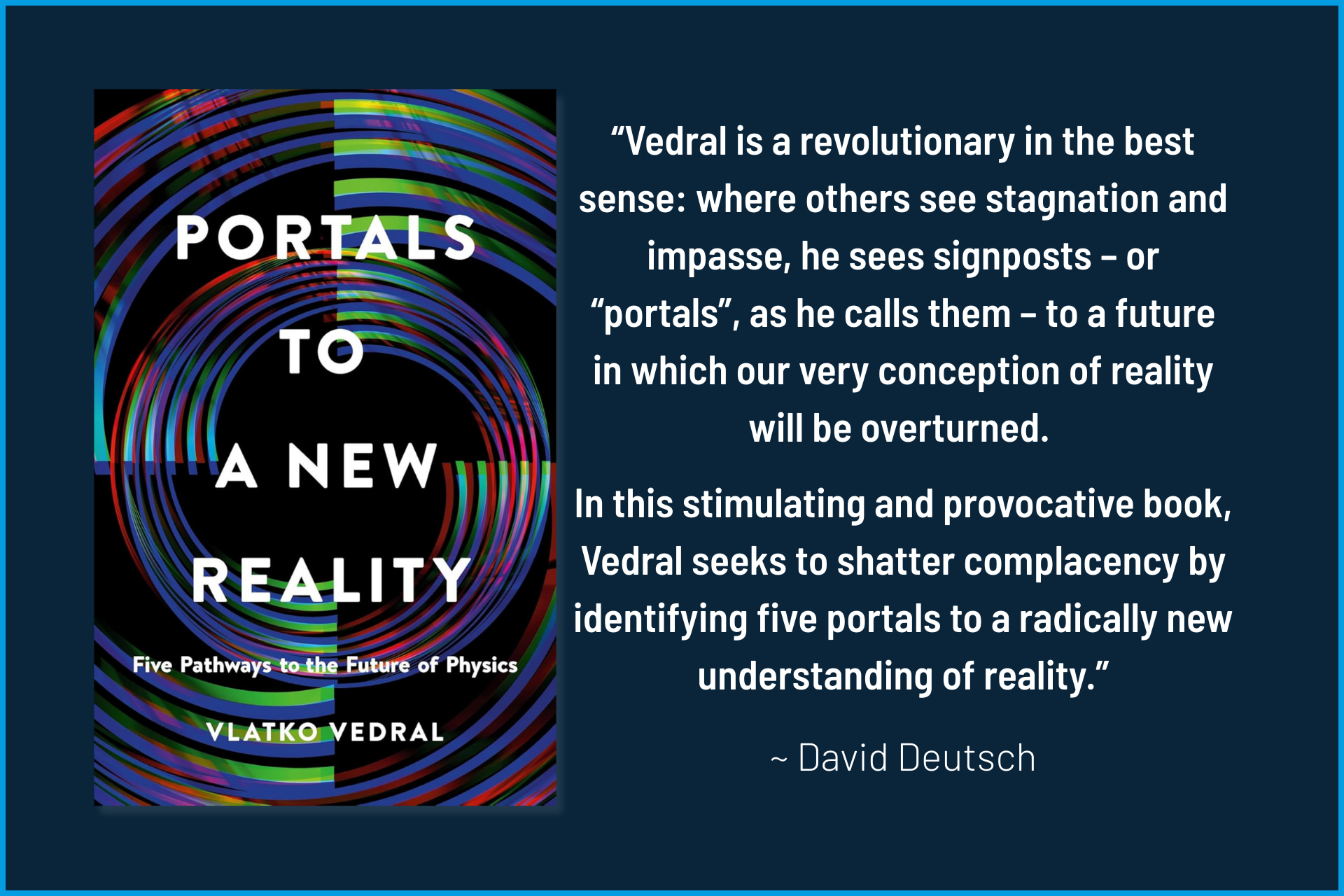
My new book is about the next revolution in physics. It explains in an accessible manner what I believe to be five key ‘thought experiments’ that will provide us with clues about what our next fundamental laws should be like. Each central chapter is about one such experiment – its motivations and how it will allow us to open a window on the future theory of physics.
We have been stuck with the same two physics theories for over one century and it’s getting pretty boring. We’d love to be in what we think was the position of physicists in 1900, having to resolve two major inconsistencies that led to two massive scientific upheavals through the discoveries of general relativity and quantum physics. However, even at that time, most leading physicists didn’t see it coming. Kelvin gave a famous Royal Society address in 1900 – at the dawn of the new century – at which he was announcing the end of physics, in the sense that everything there was to understand had already more or less been understood. Kelvin admitted that there were only two clouds on the horizon, which were the inability to detect aether and the inability to explain the black body radiation. The clouds were clearly not small, since the former led to the theory of relativity and the later to quantum physics.
I think that we are now in a similar position, namely on the brink of a new revolution. But this is not necessarily because of any existing experimental inconsistencies. Instead, quantum information has opened up new avenues for experiments which we haven’t really capitalised on yet. So, in my book, I use all these things we’ve learnt to argue that the next step might be closer than we think. It’s just that we need to look for the right things and do it with an emphasis on the fundamental physics.
And the right things to look for are 5 key experiments that probe the features of our current theories that are most questionable and problematic. In my view, they are not just small clouds on the horizon, but are actually portals into the future of physics. The interesting revelation that I have come upon during my latest 10 years of work, which is why I think the word portal is apt, is that most of these experiments are not actually that far from being technologically feasible. At present, they are just still at the level of ideas – but nothing actual is in the way of realising them, other than a huge inertia that makes us less likely to attempt ambitious new experiments. In my book, I have explained why these experiments are essential to our progress in physics, and at the same time that they have now become accessible with our current technology. It is this fact that makes the book timely and should be an exciting read for anyone curious about the current state of physics and about how we can reach the physics of the future.
The main questions are “what’s next for physics?” and “how do we get there?”. Along the way, the introduction and the first few chapters offer a fresh perspective on both quantum physics and the theory of gravity, which are the two current theories on which our entire understanding of the universe is based. I believe that my perspective is novel and different from the prevailing views that are represented in the popular press. One of the dominant ones is that quantum physics is weird and cannot possibly be true at the macroscopic scales (e.g. Penrose, Smolin). Another one is that the fundamental theory that unifies quantum physics and gravity is super esoteric (estring theory, e.g. Greene) and even not accessible to experiments (but that’s ok, a la Tegmark, who thinks that every possible mathematics is represented in some universe and we just live in one of those – clearly a view that cannot in any way be tested). There are also modern-day Lord Kelvin’s out there (Wilczek is perhaps the most prominent example) who think that the present Standard Model of physics is more or less it. Instead, I will explain how quantum theory is in fact the rock-solid basis on which these windows of the future theory can be built, and that quantum gravity and theories beyond are a natural expansion of the ideas of quantum theory to gravity, with no special mystery involved – just fascinating problems that the experiments in each chapter will uncover.
The main unique feature of this book is that it offers a new perspective on the quantum universe by presenting the unexplored territory where quantum physics gives us insights going well-beyond what is currently understood. It presents a report from the battle-front by someone who is engaged with testing quantum theory in completely new domains, such as at the interface with living systems, artificial intelligence, as well as the macroscopic objects such as gravitating masses, black holes and, ultimately, the whole universe. It is exactly from these kinds of ideas that I claim a new theory of physics is expected to emerge. Each chapter centres around the description of one experiment, each of which is seen as a portal to the new reality. I have done this in the “style of Feynman” that emphasises, in an honest way, the true spirit of the physical sciences. I’ve done my best to project the marvel and excitement regarding the open questions we are facing and the mysteries we need to grapple with in order to understand the deeper nature of reality.
I hope that my book is an exciting exposition of our intellectual adventures as we explore new physics frontiers. I would like the wider public to know that we have some major roads leading us to the future reality and that we are actually very close to exploring them. I hope that I have also communicated that what’s ahead of these roads is something that will be as exciting as quantum theory, if not more, but is not incomprehensible or esoteric. It’s going to make perfect sense and it is for this reason that it will be beautiful and fascinating.
When I write, I always have my 16-year old self in mind (though I think anyone curious about science will find the ideas exposed exciting). Indeed, I would also like to inspire the next generation of physicists to be more adventurous than the current and previous ones, and to try and realise these experiments. I would like my book to become a manifesto to champion transformative and fundamental research, advocating that we are at a fertile point in the history of physics and that we must seize this moment, both from the theoretical and the experimental points of view.
I frequently hear it said that the last century was the century of physics (as far as the fundamental discoveries are concerned) but that this century belongs to biology. I profoundly disagree with that and believe that this century too belongs to physics. I hope that this book will present a convincing argument of why this is the case.
The physics community is always split when it comes to the fundamental questions (even when it comes to what the fundamental questions are). In particular as far as quantum physics is concerned, there are many views present in the literature. One is that quantum physics will someday collapse, with a number of culprits offered by various researchers (living systems, gravity, complexity, scalability and so on). I will be arguing against all of these. While I will be saying that from the current perspective, it seems perfectly consistent and reasonable to view the whole universe as one big quantum system, it also seems likely that there will be a superseding theory to quantum physics. But this theory will be more general and will have a similar relationship to quantum physics as quantum physics has to the classical one. I have presented my logic for this point of view and offered these five doors which we have to try to open in order to take a peek at the next theory.
Sign up to my substack
BOOKS
ASK ME ANYTHING!
If you'd like to ask me a question or discuss my research then please get in touch.