Physics Is Ready for Another Revolution
I believe we are living through a rather peculiar moment in the history of physics. We possess two extraordinarily successful theories: quantum mechanics, which describes the behaviour of matter at its smallest scales, and Einstein’s general theory of relativity, which explains gravity and the structure of spacetime. Both have survived a century of experimental scrutiny. Yet they remain fundamentally difficult to reconcile.
The remarkable thing is that we have become almost too comfortable with this situation.

Photo by Kate Stone Matheson on Unsplash
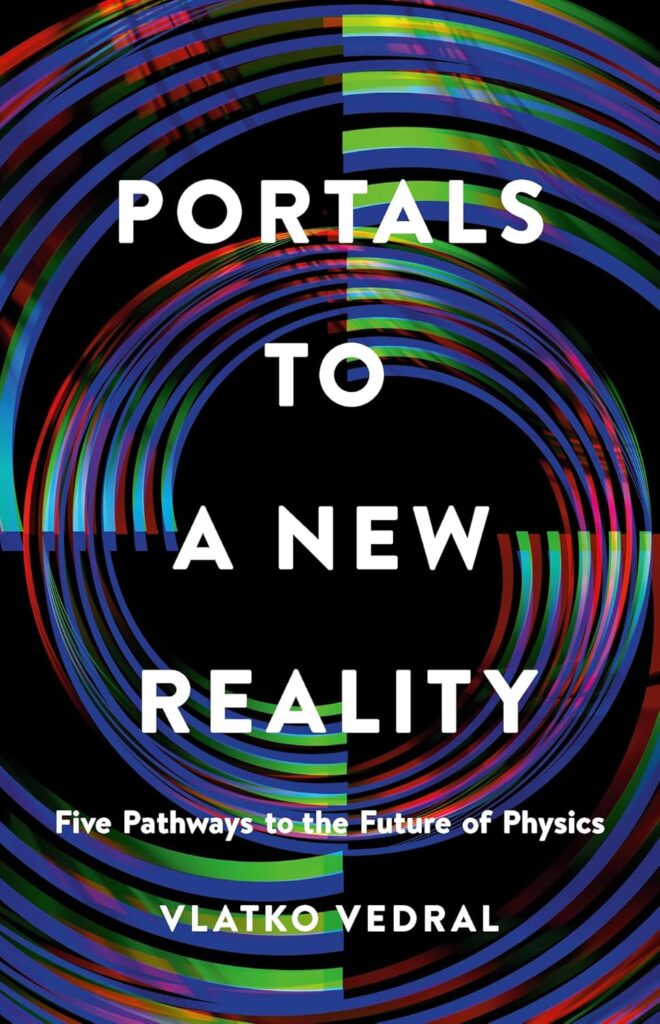
In my latest book, Portals to a New Reality, I argue that physics needs to recover something of the intellectual audacity that characterised the great revolutions of the early twentieth century. We should not be satisfied merely with improving the precision of existing measurements. We should be asking questions that might reveal that our most cherished assumptions about reality are wrong.
Consider quantum entanglement. Two particles can share a quantum state in such a way that neither can be described independently of the other. This is not simply an exotic laboratory curiosity. Entanglement may be telling us something profound about the architecture of reality itself. Indeed, I have long been interested in the possibility that information is more fundamental than matter. Perhaps the universe is best understood not as a collection of objects moving through a pre-existing space and time, but as an intricate network of quantum relationships.
This leads to an extraordinary question: could space and time themselves emerge from quantum information?
In the book, I explore five experimental approaches that might help us answer such questions. Some are so unusual that they initially resemble science fiction. Imagine extending Schrödinger’s famous cat experiment to include a human observer, placing the observer within a quantum description rather than treating consciousness or measurement as something mysteriously outside physics. What would such an experiment tell us about observation? Does the universe require an observer to possess definite properties? Or is our conventional distinction between the observer and the observed fundamentally misleading?
These questions are not merely philosophical. They concern the mathematical consistency of our theories and, crucially, what experiments might establish.
Another important possibility concerns gravity. We normally describe gravity through the geometry of spacetime, while quantum mechanics describes physical systems in terms of quantum states and probabilities. But what happens when gravity interacts with systems that exhibit quantum entanglement? Could gravity itself possess quantum properties? Might experiments involving increasingly massive quantum systems reveal where our present understanding breaks down?
What excites me is that technological advances are bringing questions once confined to philosophical speculation closer to experimental investigation.
Quantum computers, increasingly sophisticated interferometers and improved methods for controlling delicate quantum systems are giving us new ways to challenge the foundations of physics. I am not suggesting that quantum information theory has already solved every mystery. Quite the opposite. Its greatest contribution may be to expose the limitations of what we think we know.
There is a historical parallel here. At the end of the nineteenth century, many physicists believed that the essential structure of physics was already understood. Then quantum theory and relativity transformed our picture of nature. We may be approaching a comparable moment today.
My central message is that we should be more ambitious. We should design experiments that discriminate between radically different conceptions of reality, even when those experiments initially appear impossible.
Science advances not only by confirming our theories, but even more by discovering where they fail.
Ultimately, Portals to a New Reality is about intellectual courage. The universe may be considerably stranger than even quantum mechanics has led us to imagine. And the most exciting possibility is that we are finally developing the experimental tools to discover just how strange it really is.
Sign up to my substack
BOOKS
ASK ME ANYTHING!
If you'd like to ask me a question or discuss my research then please get in touch.